

Konforti
Monumental Chess Set “The Ball - A War of Luxury and Fashion” in Silver & Gold
Monumental Chess Set “The Ball - A War of Luxury and Fashion” in Silver & Gold
Previously commissioned. Each new piece is handcrafted upon request.
“The Ball - A War of Luxury and Fashion” is a monumental sculptural chess set conceived as a museum-level collectible and created within the Konforti family atelier in the spirit of the great Imperial workshops of the eighteenth and nineteenth centuries.
Executed exclusively as a private commission, this extraordinary work celebrates one of the most fascinating rivalries in European cultural history: the competition between the Imperial Court of Catherine the Great of Russia and the Royal Court of Marie Antoinette of France. While history often remembers the political conflicts of nations, this chess set explores a different battlefield-the struggle for supremacy in elegance, fashion, ceremony, and courtly magnificence.
Produced only in a very limited number of examples worldwide, each chess set requires dedicated craftsmanship and combines haute joaillerie techniques, monumental silver sculpture, hot enamel artistry, stone carving, miniature painting, and architectural design into a single unified work of art.
Due to the scale and complexity of the project, the atelier undertakes only a small number of such commissions each year. Every commission is scheduled individually, and a production slot is reserved upon confirmation of the order. Each chess set requires approximately 18 months (1.5 years) to complete.
Collectors receive full documentation, certificates of authenticity and materials, and direct communication with the atelier throughout the creation process.
Specifications & Details:
Chessboard Dimensions: Approximately 65 × 65 × 15 cm
Figure Heights: Approximately 11-13 cm
Materials: 960 Silver, 925 Sterling Silver, 18K Gold Inlay, 24K Gold Vermeil, Precious Hardwood Foundation, 24K Yellow Gold Gilt
Natural Gemstones: Lapis Lazuli, Onyx, Diamonds, Rubies, Sapphires, Emeralds, Topaz, Garnets, Tsavorites, Tourmalines, Pearls, Chalcedony
Decorative Techniques: Precious Metal Sculpture, Hot Transparent Enamel, Artistic Casting, Chasing, Hand Engraving, Repoussé, Stone Carving, Gold and Silver Inlay, Gemstone Setting, Lacquer Miniature Painting, Architectural Metalwork
Production: Made to Order, Exclusive Private Commission
Lead Time: Approximately 18 Months (1.5 Years) from Order Confirmation
Edition: Very Limited Number of Examples Worldwide
Historical Inspiration
The Rococo period transformed court life into a continuous celebration of luxury, refinement, and theatrical spectacle.
Two courts dominated Europe during this age:
The Court of Queen Marie Antoinette and King Louis XVI of France and
The Court of Empress Catherine II (Catherine the Great) and Prince Grigory Potemkin of Russia.
Although Russia and France were political competitors, they were equally engaged in a cultural contest for the title of Europe's most magnificent and extravagant court.
In many respects, these courts were shaped by two remarkable women. Marie Antoinette became the supreme icon of European fashion and elegance, while Catherine the Great transformed Russia into one of the leading cultural powers of the continent.
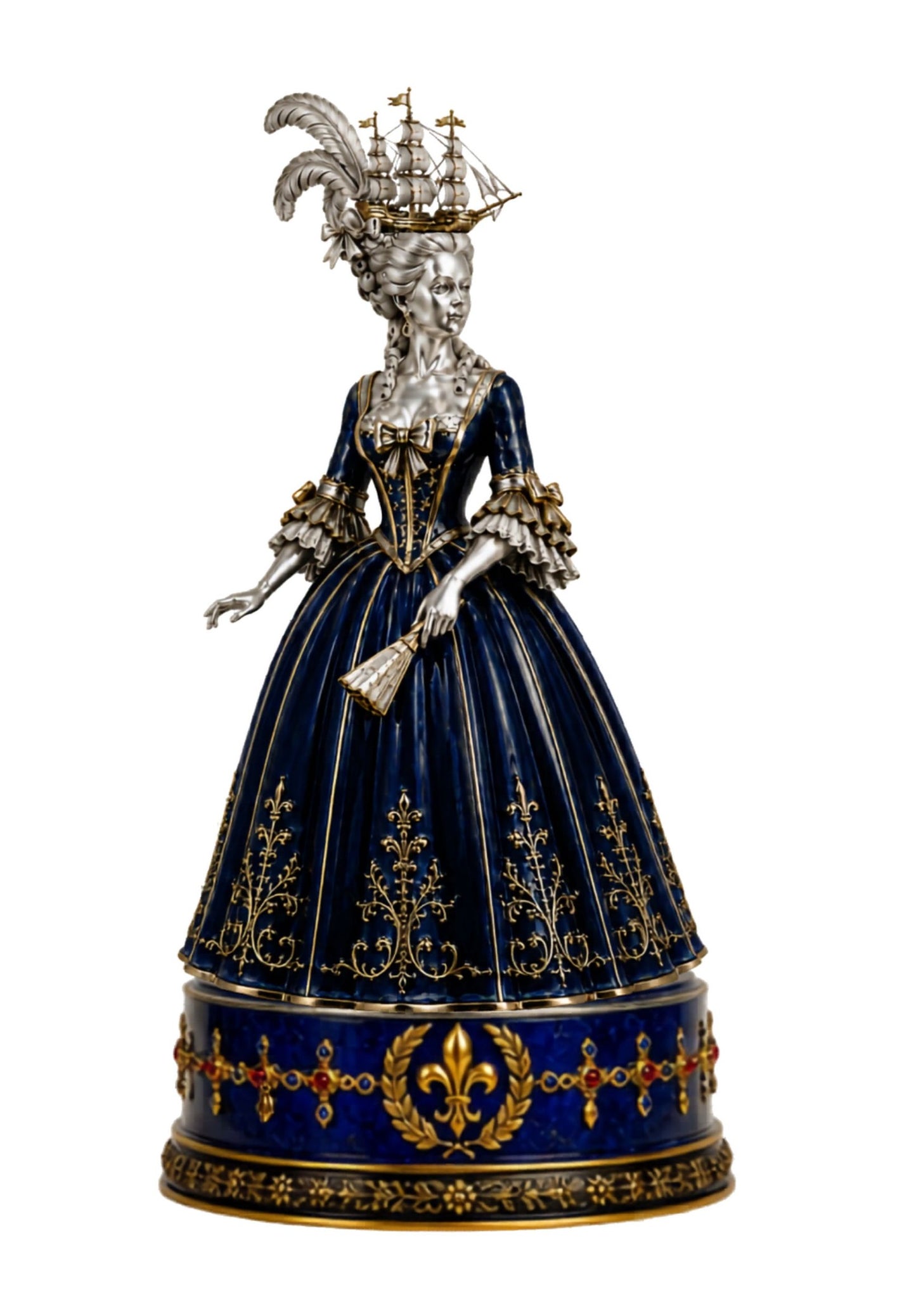
Their courts competed through architecture, jewelry, celebrations, military splendor, music, and fashion. The rivalry extended even into hairstyles. At the French court, elaborate powdered coiffures adorned with miniature ships became symbols of prestige and propaganda. The famous “à la Belle Poule” hairstyle commemorated the victory of the French frigate Belle Poule and inspired fashion trends throughout Europe.
Russian aristocrats soon adopted similar fashions, incorporating miniature ships into court hairstyles as symbols of Russia's growing naval power. It was a competition not only of politics and military prestige, but also of imagination, luxury, and spectacle.
The grand balls of Catherine the Great and Marie Antoinette represented the pinnacle of eighteenth-century elegance. Guests appeared in enormous powdered wigs, corsets, pannier gowns, jewels, lace, and richly embroidered silks. At the center of these celebrations stood the majestic Minuet, a dance emphasizing grace, etiquette, and ceremonial movement.
This extraordinary chess set captures that world.
A Chess Set and a Theatrical Stage
Unlike traditional chess sets, “The Ball - A War of Luxury and Fashion” transforms after the game is finished.
During play it functions as a complete classical chess set.
When the pieces are rearranged, however, the composition becomes a grand ballroom scene.
Four additional figures-two Russian court ladies and two French court ladies-join selected officers to recreate the elegant Minuet danced at the courts of Catherine the Great and Marie Antoinette.
Between the architectural pavilions positioned at the corners of the board stand celebrated violinists and cellists of the period, performing for the assembled guests. Kings and queens observe the festivities while elite guards from both nations stand watch over the magnificent spectacle.
The result is both a playable chess game and a miniature theatrical stage celebrating one of the most glamorous periods in European history.
As one contemporary observer of these courts reportedly remarked:
"Everything shines and resounds. A war is being fought for supremacy in fashion, splendor, and beauty. It is a celebration of the joy of life. It is the Ball."
The Figures
French Court
King: Louis XVI
Queen: Marie Antoinette
Officers and Aristocrats: Count Hans Axel von Fersen, Duke de Lauzun
Additional Ballroom Figure: Duchess de Polignac
Violin Virtuosos: Giovanni Battista Viotti, Chevalier de Saint-Georges
Cello Masters: Luigi Boccherini, Anton Kraft
Soldiers: Swiss Guards of the French Royal Household
Russian Court
King: Prince Grigory Potemkin
Queen: Empress Catherine II (Catherine the Great)
Officers and Aristocrats: Count Semyon Zorich, Count Alexander- Dmitriev-Mamonov
Additional Ballroom Figure: Countess Praskovya Bruce
Violin Virtuosos: Ivan Khandoshkin, Anton Ferdinand Titz
Cello Masters: Jean-Louis Duport, Jean-Pierre Duport
Soldiers: Elite Guards of Catherine the Great, including the Semenovsky and Izmailovsky Regiments
Architectural Composition
The monumental chessboard is conceived as a Rococo palace transformed into a ballroom.
Elegant pavilions crowned with imperial domes occupy the corners of the composition, while ornate balustrades, gemstone-set architectural details, and ceremonial emblems surround the playing field.
The side panels feature elaborate scenes of aristocratic life, court celebrations, gardens, music, and dancing, executed in an exclusive lacquer miniature painting technique and enriched with precious metals and gemstones.
The central panel reveals a magnificent ballroom illuminated by chandeliers and grand staircases, evoking the atmosphere of the most lavish celebrations held at Versailles and the Winter Palace.
Every architectural detail has been designed to create the impression that the viewer is looking into a miniature Imperial world frozen in a moment of elegance and spectacle.
Materials and Craftsmanship
The side-panel paintings are executed in an exclusive lacquer miniature technique enriched with 18K gold, silver, and gemstone inlay.
This work brings together numerous traditional luxury arts techniques, including precious metal sculpture, hot transparent enamel, artistic casting, chasing, hand engraving, repoussé, stone carving, gold and silver inlay, gemstone setting, lacquer miniature painting, and architectural metalwork.
Every figure is individually sculpted and finished by hand.
Commission and Personalization
Each chess set is created exclusively for its collector.
The commission process allows for discreet personalization, including selected gemstone variations, color interpretations, heraldic elements, and other bespoke details, ensuring that every completed work remains unique.
The atelier also accepts fully custom commissions for entirely original chess compositions and historical themes.
From the first sketches through the final sculptural execution, every stage is developed in close collaboration with the client.
Atelier and Provenance
Each work is created within the Konforti family atelier, a multi-generational workshop led by Inga and Barak Konforti, continuing the artistic legacy established by master artists Ella and Yuri Bogoslavsky.
Every piece is entirely handcrafted using traditional techniques, combining sculpture, jewelry arts, enamel work, miniature painting, and gemstone setting.
As part of the commission, the collector receives a complimentary signed original design sketch, presented as part of the artistic provenance of the work.
Shipping and Delivery
Complimentary worldwide shipping and full insurance are included.
Because of the scale, value, and complexity of the chess set, delivery is arranged individually through specialized fine-art logistics providers. Museum-standard crating, white-glove handling, and fully insured transportation are coordinated according to the destination and collector's preferences.
Final Note
“The Ball - A War of Luxury and Fashion” is not merely a chess set. It is a sculptural theatrical composition, a celebration of the rivalry between two of the most magnificent courts in European history, and a tribute to the art, music, fashion, and grandeur of the Rococo age.
Created at the intersection of fine art, historical storytelling, architecture, and haute joaillerie, it is conceived as a generational masterpiece intended to stand among the great traditions of Imperial decorative art.